WildNature Electric Hub Motor Kits  - Fast -Strong-Silent

      Tech and Sales > 1- 360-385-9910            Open 7 days a Week  9am-9pm
   GUS   VERTICAL 
     WIND TURBINES

       Home
Hydro-Electric
Turbines
_______
iGust 11 Blade
Wind Turbines

Hydro Electric
Turbines !

Ultra - Capacitors!
    BIG ONES!

Electric Bike
Motor Kits

Solar Panels
Pure Sine Wave
Inverters

Modified Sine Wave
Inverters

Plug-In-The Wall
Inverters
Savanna's
Sky-Catchers !

Lithium Batteries
24/36/48 volts

Solar Charge
Controllers

Wind Charge Controllers
Watercone !
Solar h2o  Distiller
FireWinder! Wind
  Powered Light
Watt's Up Meter
Data Logger

Rocket Trike !
The coolest thing !

Kill-a-Watt Meter
Digital Multimeters
LED  FLASHLIGHTS
Big/Bright/Tough

Solio Solar Cell
Phone Charger

Savanna's Video / Photo Gallery
Savanna's T-Shirt
Photo Gallery

Neodymium
Magnets

Extreme Bright
LED's


                              tt

   tt

ii  ii  tt

  Phoenix II  Hub Motor Boot Camp
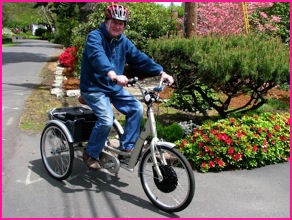
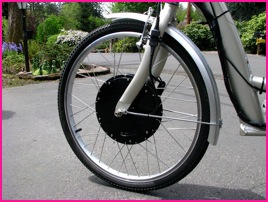
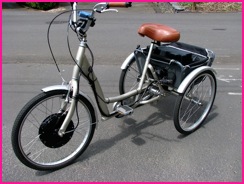
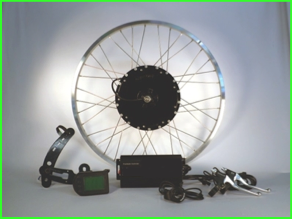
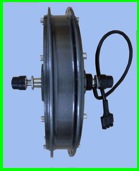
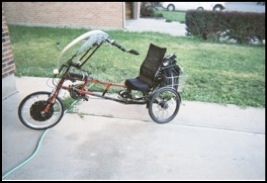
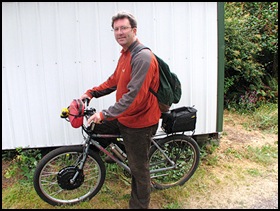
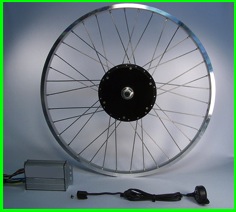
Phoenix II Motors are available in front and rear models. Front motors fit 100mm dropouts and rear motors fit 135mm dropouts, the standard for mountain bikes, cruisers, recumbents, adult trikes, tadpoles, and just about everything else except road/racing bikes. All Phoenix II motors are disc brake compatible. Just move your existing disc rotor from your old hub to your motor. If you have rim brakes, no sweat. We use rims compatible with standard hand brakes.

Front versus Rear Drive
Each has advantages and disadvantages. To start, Phoenix II front motors are 10lbs and rear motors are 16.25lbs. You probably guessed that rear Phoenix II motors also have more power than front motors.....so it's give and take, a very familiar idea to those in the LEV industry. You may have also guess that you'll have less range with rear motors if you ride like us...full throttle all the time! Face it, if you are using more power, it's going to run out faster given the same size "fuel tank". However, that doesn't mean you "have" to use more power all the time either, so you can have the same range with a rear motor as a front if you keep to that power level. Non-performance related differences may include that usually the rider is more aware of what the front wheel is doing. If it starts to spin, the rider has an additional plane of control. That is, you can turn the front wheel to maintain balance and correct for the spinout. The front wheel has less weight on it though, so it will spin more easily. Steep hills on non-paved surfaces can be a problem for this reason. Rear wheel drive has the advantage of better traction, but if you apply too much throttle on a turn and the wheel starts to spin, you will probably hit the ground as the bike goes out from under you (you can't turn the rear wheel as you can a front to correct for the slip). If sticking to the standard one-size-fits all battery mounting arrangement, rear drive puts the entire weight of the system on the rear of the bike rather than battery weight in back, motor weight in front. On the other hand, some of the best conversions we've ridden had rear wheel drive and the customer mounted the batteries in the triangular part of the frame toward the front. Weight distribution can be important, especially for 72V systems due to battery weight. Rear dropouts on bikes are heavier than front, and can take more torque. If you use a rear drive, you can still have front suspension. If you use front wheel drive, make sure you are not using carbon fiber, aluminum, or anything weaker than steel. Believe it or not, carbon fiber is NOT good for a Phoenix II motor because carbon fiber is made with strands that are strategically placed based on the direction of stresses that will be presented to it. Since bike frames are stressed in about every direction, it makes carbon fiber a fairly poor material to use for bike frames, especially the area of your dropouts....hence being horrible for a hub motor. They tend to hold up under regular biking circumstances, and when handled with care, but a Phoenix II is sure to destroy it.

Front      Rear  tt       rr


Cruiser versus Brute
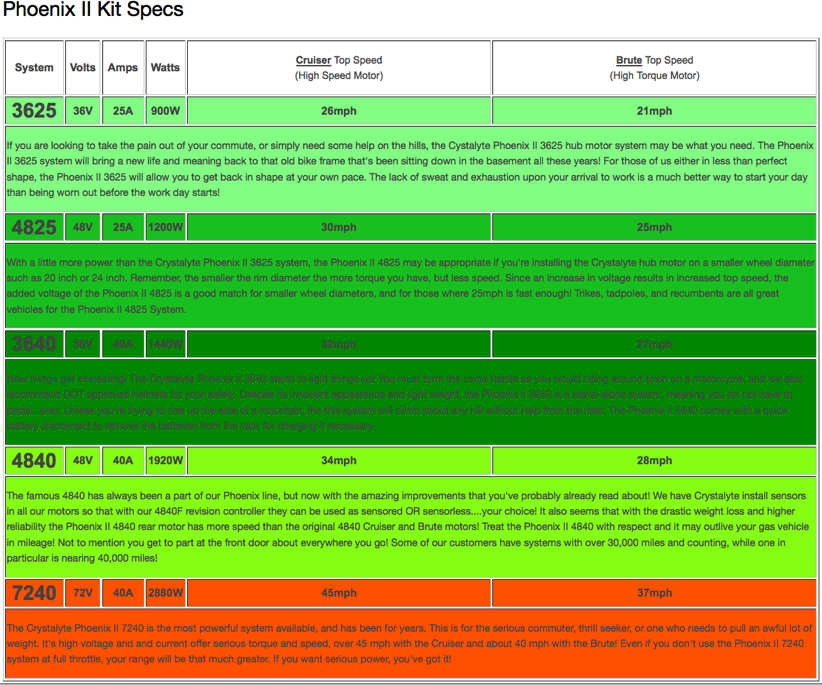
Cruiser and Brute look physically identical. The difference is in the windings inside the motor. Cruiser is wound for higher speed, which means less torque than Brute. If you have a wheel size smaller than 26 inches, you will probably want to choose the Cruiser. If your wheel is 26 inches or 700c, it depends on your terrain and the type of traffic you will ride in. If you have a lot of stop-and-go and/or your speed limits are 25 MPH or below, Brute would be a better choice. Since Brute is wound to favor torque over speed (compared to Cruiser), it uses less energy to produce acceleration, and since you won't be exceeding its top speed anyway, the top speed of a Cruiser would be wasted. On the other hand, if you're traveling mostly county roads or paths where you can pour on some speed, THE Cruiser is better!

Throttle Types
Full Twist  tt  Thumb  tt
All our throttles are compatible with all our controllers. While lighted throttles are still available, the APM-Display eliminates the need of LED indicators on the throttle. All Phoenix II kits include a non-lighted throttle. The lighted throttles that show approximate range remaining need to be the same voltage as your system to be accurate, but while the light-gauge needs to match the system voltage, the throttle part is voltage-independent, meaning you can use any throttle on any system regardless of voltage. NOTE: Half-twist and full-twist throttles have the same range of twisting motion, so don't be confused! "Half-twist" simply describes the length of the throttle, not its range of twisting motion.
Thumb Throttle - Uses a thumb lever to apply throttle, and takes up the least amount of space on your handlebars. If you have a twist-grip shifter, you must choose a thumb throttle due to the limited space on your handlebars.
Full-Twist Throttle - Like a motorcycle throttle

Helpful Tips, Basic Facts and Misc. Information:
This section is meant to provide bits and pieces of information that should help you to gain a more clear understanding of your options, and which options to choose. While much of this information can be found in various places on our website, we've grouped them all into one section for easy reading and navigation.
Regular Bicycle Information:
We are not bicycle experts, not even close. We have learned much over the years, but the bicycle industry is constantly changing. Instead of being mediocre in two totally different fields, we chose to be experts in one... electric hub motor systems. We have found one site in particular to be very informative when we've needed to research anything in the bicycle industry: http://www.sheldonbrown.com. We can't verify all the information is correct, but have found no reason to question its accuracy. It's obvious its creators are very well educated in the bicycle industry...so we recommend using it as a reference for any bike questions you may have! You local bike shop is another great source for this information.
Batteries:
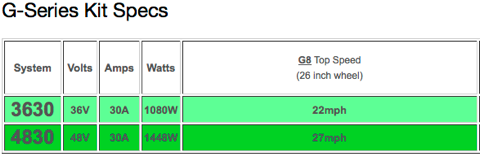
Relatively speaking, increased voltage will increase your speed while increased current (Amps) will increase your torque.
Do not confuse "Amps" and "Amp Hours", they are completely different unit of measurement. Amps are a measurement relating to power, also known as current. The higher your amp rating, the higher your torque and overall power. Amps can somewhat relate to the gas industry as in how many cylinders your car engine has, which has much to do with the amount of power it has. Amp Hours are a measurement relating to battery capacity, or range. The higher your amp hour rating, the further you can travel per charge. Amp Hours can relate to the gas industry as in how large your gas tank is....which has much to do with how far you can travel before refueling.
Sealed Lead Acid batteries are generally available in 6V and 12V, although 12V are more standard in the LEV industry.
A 36V system will have 3 12V batteries, a 48V system will have 4 12V batteries, and a 72V system will have 6 12V batteries.
Sealed Lead Acid (SLA) batteries typically offer 250-350 recharge cycles for electric vehicles. For the average rider, this is about 2 years. For commuters who recharge twice a day, this could be 6 months.
SLA batteries DO have a shelf life, meaning they drain very slowly when not in use. If left uncharged for a period of months, SLA batteries will be permanently damaged. We recommend charging your batteries once every 2 weeks when not in use.
Never exceed more than half the amp hour rating of your battery pack with the amount of amps you are charging with. For example, you would never want to use more than a 6A charger for a 12AH battery pack.


Chargers:
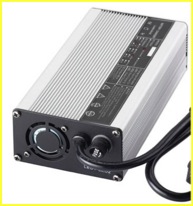
All chargers we supply are "smart" chargers, meaning they can be left plugged into the battery pack indefinitely without causing damage. A good rule of thumb is "If the bike is not on the road, it's on the charger".
tt
Chargers do get HOT! Never charge near anything flammable. We recommend placing your charger on concrete, at least 6ft away from anything flammable.
To determine charge time in hours, divide the amp hour (AH) rating of your battery pack by the amp (A) rating of your charger. Example, it takes about 4 hours to charge a 12AH battery using a 3A charger (12AH/3A = 4hrs).
To an extent, charge speed effects charge quality. The slower you charge your batteries, the better quality of charge your batteries will receive. While you "can" charge a 12AH pack in 2hrs with a 6A charger, you will notice less range than if you were to charge with a 2A charger.

Motors:
Phoenix II motors include only the Cruiser and Brute. The Racer has been discontinued.   (@ 45MPH+ it was just too fast ! )
The smaller your wheel diameter, the more torque you will have, but lower top speed. The larger your wheel diameter, the less torque you will have, but higher top speed. Wheel diameter is a huge factor in determining which system is right for you. If you have a 20 inch wheel, in most cases we will recommend a Cruiser. There aren't many vehicles or applications that would require the torque of a Brute on a 20 inch wheel.
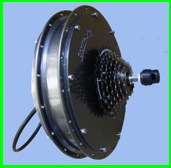
A 1-8 speed freewheel can be used with rear Phoenix II motors. Some 8-speed freewheels may require installing a flat washer between the fork and motor to space the freewheel from the frame.
Front motors use a torque arm, rear motors do not.
Phoenix II motors are "based" on Crystalyte's HT and HS motors, but supply more power than the base models. We call our motors Phoenix II, which can be identified as having glossy-black paint, and a lot more power! All standard HT and HS motors are silver.
Phoenix II motors can be laced to 20in, 24in, 26in, and 700C (27in) rims.
Phoenix II motors are laced with 12g spokes which are twice as thick as 13g (standard) mountain bike spokes.
Keeping spokes tight is critical. Loose spokes WILL break eventually.
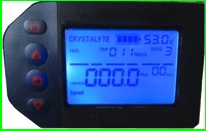
Phoenix II systems use sensorless technology, meaning there are no electronics inside the motor, thus eliminating any possible failure points inside the motor. The controller now does ALL the work.

Still not sure which system you need?
No doubt about it, choosing the right system is crucial to years of enjoyment. We want to help you choose the right system the first time. Give us a call or send an email to sales@electricrider.com. Some of the things we'll be asking you:
1. What type of vehicle will you be converting?
2. What is the tire size of the wheel you plan to install our motor? NOTE: Actual rim diameter is different than the tire size. A 26 inch rim is really 22 inches in diameter. Be sure to report the actual size stamped on the sidewall of the tire!
3. What top speed would you like?
4. What type of terrain will you be riding on? Is it mostly hills, flats, or a combination of both? About how steep is your steepest grade?
5. How far do you need to travel per recharge?
6. How much weight will the Phoenix II need to carry or pull? Include the weight of a trailer if applicable.
7. Do you plan to pedal with the system?
8. Do you need to lift the vehicle on a regular basis? IE, will it need to go on a bike rack or in a pickup.


              THE NITTY GRITTY !! ( Prices )


Contact Us
    tech/ customer support
   1-360-385-9910
  
Email:   wildnaturesolutions@gmail.com
   (Open 7 days and Evenings too!)
>>>   If you think there is something on this site    <<<
                  that might be of interest to someone
                  near and dear, a Gift Certificate
                  might be just the thing!!


Get Your Own Visitor Map!

free counters


free counters